


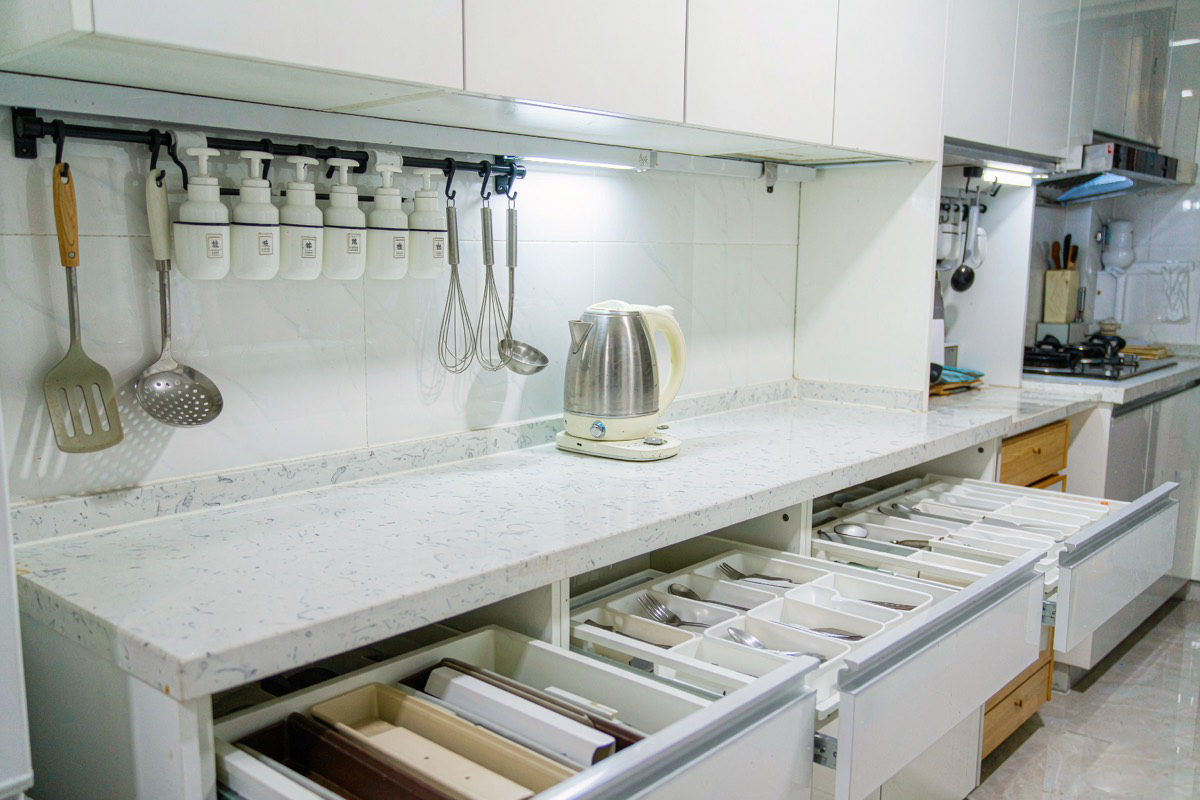
Kitchen organization is different from other spaces: it is used frequently every day, and you also have to account for cooking fumes, moisture, and retrieval efficiency. So the goal of kitchen organizing is not "hiding more," but"using smoothly + putting away quickly"。
Rule 1: Keep the countertop "zero exposed," leaving only 3 items
Keep only up to three things on the countertop that are essential every day: for example, an electric kettle, a rice cooker, and a commonly used cutting board. Put everything else on the wall or in cabinets. The fewer visible items on the countertop, the more immediate the effect of making the kitchen look bigger and cleaner.
Rule 2: Zone by "workflow," not by "category"
Many people store all cookware in one place and all seasonings in one place, and as a result they run back and forth while cooking. The correct approach is to place things according to the cooking workflow:
Take (refrigerator zone):Leave a prep countertop next to the refrigerator;
Wash (sink zone):Hang dish soap and steel wool pads by the sink;
Cut (prep zone):Put knives, cutting boards, and commonly used seasonings in this area;
Cook (stove zone):Put oil, salt, soy sauce, vinegar, and spatulas within arm's reach of the stove.
Rule 3: Create "secondary zones" inside drawers
If drawers are not divided into zones, they will definitely become messy within three months. Usedrawer divider boxesto separate tableware and tools, with one compartment for each category of items. Place chopsticks and spoons upright (using an upright divider box) so they are clear at a glance when you take them out, with no need to rummage.
Rule 4: Use uniform containers + labels for seasonings
The bottles and jars bought from supermarkets vary in height and shape, which is the root cause of countertop clutter. Replace them all with the same style of seasoning bottles and add labels. They look good and are less likely to be mistaken. Store backup seasonings that are not commonly used in wall cabinets, and keep only the ones currently in use on the countertop.
Rule 5: Do not waste the space under the sink
The space under the sink is the most easily overlooked storage area in the kitchen. Use an expandable shelf to create layers: put cleaning agents on the upper layer, and put backup dish soap stock and garbage bags on the lower layer. Be careful to avoid the drain pipe area, and add a moisture-proof mat in places with heavy dampness.
A one-step solution: hire a professional organizer for a kitchen-specific organizing session
Kitchen organizing involves workflow design, selection of cabinet tools, and suggestions for decluttering items. Figuring it out on your own often requires repeated rework. A professional home organizer doing a kitchen-specific organizing session (including screening expired foods, zoning inside cabinets, and workflow planning) usually completes it in 3-4 hours, after which you save at least 15 minutes every day when cooking.
Service hotline: 16621783413 (same number on WeChat)